How could climate change reshape bird migration and HPAI?气候变化如何重塑鸟类迁徙与高致病性禽流感风险?
Climate change and highly pathogenic avian influenza (HPAI) are often discussed as separate global challenges, but they increasingly intersect through the ecology of wild birds. In our 2023 Comment article, we asked how long-term climate change and short-term extreme weather events could influence HPAI not only by changing where birds move, but also by altering host population dynamics, individual physiology and immunity, and how long influenza viruses persist in the environment [1].气候变化和高致病性禽流感(HPAI)常被视为两个不同的全球性问题,但二者正通过野生鸟类生态产生越来越紧密的联系。我们在2023年发表于 Nature Microbiology 的一篇 Comment 中提出:长期气候变化和短期极端天气事件,可能不只是改变鸟类去哪里、何时迁徙,还会影响宿主种群动态、个体生理与免疫状态,以及流感病毒在外界环境中的存留时间 [1]。
The goal was not to argue for one simple climate-to-disease pathway. Instead, we proposed a multiscale framework for thinking about how climate, bird ecology and virus dynamics can interact, sometimes in reinforcing ways and sometimes in opposite directions.我们并不是想建立一条简单的“气候变化导致更多禽流感”的因果链。相反,我们希望提供一个跨尺度的概念框架,用来理解气候、鸟类生态和病毒动态之间如何相互作用。有些作用可能彼此叠加,也有些可能方向相反。
Climate change acts at more than one scale气候变化作用于不止一个尺度
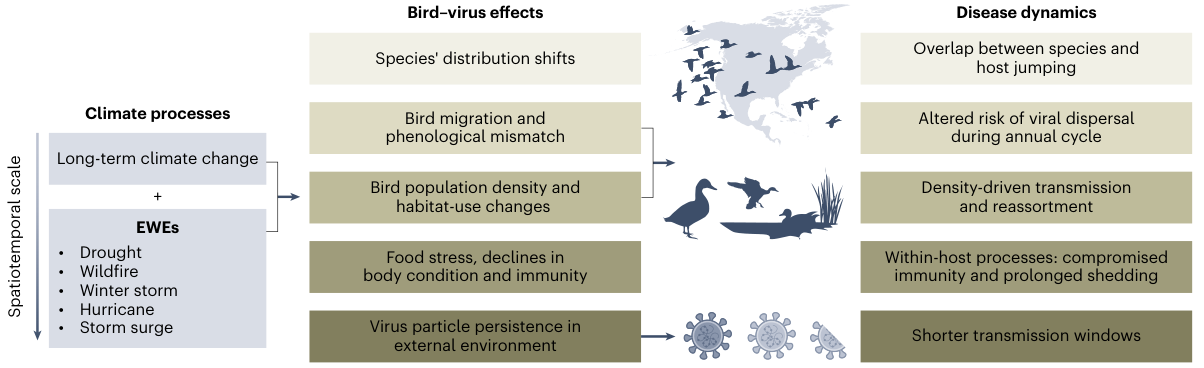
Long-term climate change can gradually alter temperature, precipitation, sea level, vegetation and water conditions. At the same time, extreme weather events such as droughts, wildfires, winter storms, hurricanes and storm surges can produce much faster ecological responses. Together, these processes can shift species distributions, migration timing, population density, habitat use, body condition and virus persistence outside the host [1].长期气候变化会逐渐改变温度、降水、海平面、植被和水文条件。与此同时,干旱、野火、冬季风暴、飓风和风暴潮等极端天气事件,则可能在更短时间内引发生态响应。两类过程都可能改变物种分布、迁徙时间、种群密度、栖息地利用和宿主个体身体状况,也会影响病毒离开宿主后在环境中的存留 [1]。
When bird movements change, virus pathways can change鸟怎么移动,病毒的传播路径也可能随之改变
Many important avian influenza hosts, including waterfowl, shorebirds and gulls, are migratory. Their movements connect breeding, stopover and wintering areas, creating routes along which viruses can disperse. Climate-driven shifts in migration timing or species ranges can therefore create new contacts between populations that previously overlapped less, or remove contacts that once occurred regularly [1].在水鸟等重要禽流感宿主中,许多物种都具有迁徙行为。它们在繁殖地、停歇地和越冬地之间移动,也在地理上连接了不同区域,为病毒扩散提供了潜在路径。因此,气候驱动的迁徙时间或分布范围变化,可能让原本接触较少的种群产生新的重叠,也可能使过去较稳定的接触消失 [1]。
For example, warming can shift wintering ranges poleward and advance spring migration. Extreme weather can also cause birds to abandon territories, form new mixed flocks, or move into human-modified habitats. Reduced snow cover can make agricultural fields accessible for longer periods and may even reduce the need for some populations to migrate, potentially increasing contact at the wildlife-agriculture interface. None of these changes automatically means higher HPAI risk. The direction of the effect depends on which species move, where they go, how densely they aggregate, and which populations they encounter [1].例如,气候变暖可能使一些物种的越冬分布向高纬度移动,并使春季迁徙提前。极端天气也可能迫使鸟类离开原有区域,形成新的混合群体,或更多进入人类改造的栖息地。积雪减少还可能延长农田食物资源的可利用时间,使部分种群减少迁徙,从而增加野生鸟类与禽畜之间的接触机会。但这些变化并不意味着 HPAI 风险一定会上升。最终的影响方向取决于哪些物种发生了移动、它们去了哪里、聚集程度如何,以及因此接触到了哪些新的种群 [1]。
Several major HPAI expansion events have also coincided with unusual weather conditions, including severe cold or major storms. These temporal coincidences do not demonstrate that the weather events caused the viral expansions, but they highlight why rapid, weather-driven changes in bird movement deserve closer study.历史上几次 HPAI 大范围扩张也曾与异常天气条件在时间上重合,包括严寒和大型风暴。这样的时间重合并不能证明极端天气直接导致了病毒扩张,但它提示我们,天气在短时间内改变鸟类移动的能力,值得在未来的禽流感研究中被更认真地考虑。
Climate can affect both the host and the virus气候同时作用于宿主,也作用于病毒
Movement is only one part of the framework. Climate can also change host populations. Earlier migration and longer breeding seasons could increase reproductive success in some populations, producing more immunologically naive juveniles and potentially more opportunities for transmission. In other cases, a mismatch between migration timing and food availability can reduce reproductive success or population size, which could lower transmission opportunities [1].鸟类移动只是这个框架中的一部分。气候变化还会改变宿主种群本身。在一些种群中,更早的迁徙和更长的繁殖季可能提高繁殖成功率,带来更多尚未建立免疫的幼鸟,从而增加病毒传播的机会。另一种情况是,迁徙时间与食物资源变化不同步,形成物候错配,进而降低繁殖成功率或种群数量,这反而可能减少传播机会 [1]。
At the individual level, food limitation, migration, reproduction and extreme weather all affect energetic condition. Birds in poor condition may have weaker immune responses, potentially allowing longer viral replication, greater shedding or more severe disease. Conversely, shorter or less energetically demanding migrations could improve a bird’s ability to control infection. These mechanisms remain difficult to predict because climate can affect physiology and infection in multiple, interacting ways [1].在个体尺度上,食物不足、迁徙、繁殖和极端天气都会影响宿主身体状态。身体状况较差的鸟类可能出现较弱的免疫反应,从而延长病毒复制时间、增加排毒,甚至加重疾病严重程度。相反,如果越冬地向高纬度移动使迁徙距离缩短、能量消耗降低,个体控制感染的能力也可能增强。气候对生理状态和感染过程的作用往往是多重且相互作用的,因此很难用单一方向来概括 [1]。
The virus itself also responds to environmental conditions. Influenza particles generally persist less well in warmer, drier or more saline conditions, whereas rainfall and flooding can expand the amount of standing water available for environmental transmission, while also potentially diluting virus concentrations. Extreme temperatures and repeated freeze-thaw cycles may further alter virus stability. Climate change can therefore change both where hosts encounter one another and how long infectious virus remains available outside them [1].病毒本身同样受到环境条件影响。流感病毒颗粒通常在更温暖、干燥或高盐度的环境中存留时间较短。降雨和洪水则可能扩大积水面积,为环境传播提供更多空间,同时也可能稀释水体中的病毒浓度。极端温度以及反复冻融也可能进一步改变病毒稳定性。因此,气候变化既可能改变宿主在哪里、如何相遇,也可能改变具有感染性的病毒在宿主体外能够存留多久 [1]。
What do we need to understand next?接下来需要回答什么?
We highlighted three broad questions. First, how will changing contacts among bird populations alter viral reassortment, cross-species transmission and evolution? Second, how will birds’ physiological responses to climate change and extreme weather affect infection within individual hosts? Third, how will changing temperature, water conditions and other environmental factors alter virus persistence and transmission outside the host? [1]我们在文章中提出了三个较大的问题。第一,鸟类种群之间接触关系的改变,会如何影响病毒重配、跨物种传播和演化?第二,鸟类面对气候变化和极端天气时的生理反应,会如何改变宿主体内的感染过程?第三,温度、水文和其他环境条件的变化,又会如何影响病毒在宿主体外的存留和传播?[1]
Answering these questions requires combining approaches that are often studied separately: GPS tracking and biologging, remote sensing and climate data, field surveillance, laboratory infection studies, genomic and other molecular tools, and ecological modeling. The same framework also needs to cross national and disciplinary boundaries because migratory birds, viruses and weather systems do not remain within administrative borders.回答这些问题,需要把过去常常分开研究的方法真正结合起来,包括 GPS 追踪和生物记录、遥感与气候数据、野外监测、感染实验、基因组及其他分子生物学工具,以及生态模型。这个研究框架也必须跨越学科和国界,因为候鸟、病毒和天气系统都不会被限制在行政边界之内。
Following a changing bird-virus system追踪一个不断变化的“鸟—病毒”系统
The broader message is that climate change does more than move birds north or change the timing of migration. It can reorganize the ecological system in which HPAI circulates, from the physiology of an individual bird to the connectivity of entire flyways and the persistence of virus in water and other environments. Understanding future HPAI risk therefore requires following the birds, the virus and the changing environment together [1].这篇文章想表达的核心并不只是“气候变暖让鸟往北移动”或“迁徙时间发生变化”。更重要的是,气候变化可能重组 HPAI 所处的整个生态系统,其影响可以从单只鸟的生理与免疫状态,一直延伸到整个迁徙路线的连接格局,以及病毒在水体和其他环境中的存留。要理解未来的 HPAI 风险,我们需要同时追踪鸟类移动、病毒和不断变化的环境 [1]。